Introduction
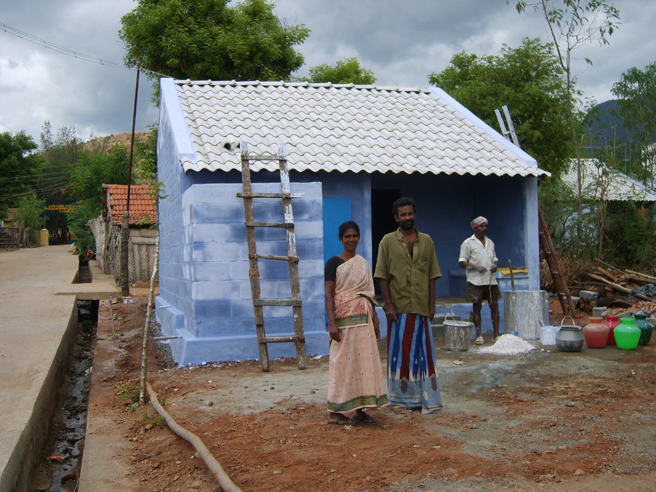
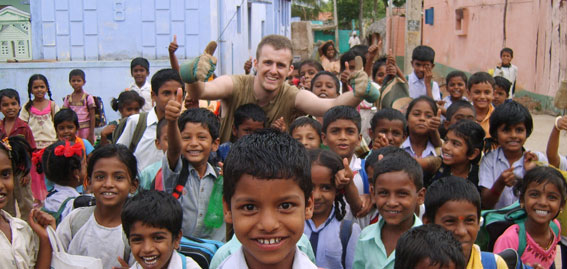
This summer, a team of eleven young people from the Lasallian Developing World Projects (LDWP) were in a town called G. Kallupatti in the state of Tamil Nadu, helping to build twelve houses for disadvantaged families, in conjunction with local charity Reaching The Unreached (RTU). All of these families are very poor and some families had lost one parent to Aids, leaving just a single parent to look after the children. Some of these children would also be HIV+. These houses will save the families from incurring the cost of rebuilding their flimsy huts every year. The huts are often made from entwined coconut leaves and mud. Some are ‘lucky’ enough to have a tin roof. Before starting work on the new house, the old hut would have to be demolished. This proved to be a difficult experience for the team, as we had to empty it first. It took far less time to empty the huts of the families’ entire possessions than it would take to empty any one of our rooms at home. It was also someone’s home that we were destroying, though there was plenty of consolation knowing that it was about to be replaced with a fine permanent structure.
Work involved
The team was made up of four boys and seven girls, from Scotland and England. All of the team bar one are students, either having just finished school or studying at university, luckily allowing us all plenty of time off in the summer to work on a building site as well as experiencing the Indian way of life! I was personally privileged enough for it to be my fifth project, although the first time in India. Of course, none of the team are construction experts - aside from very limited skills learned on previous projects - so we were assisting local builders as extra (unpaid) labourers. Our main work seemed to consist of lots of digging, which was the first job to do in order to lay foundations. However, this came at a time when none of us were acclimatised to the forty-degree heat, so it proved to be very tough. Other tasks included ferrying breezeblocks and cement. Nevertheless, we eventually learned how to lay bricks amongst other more skilled jobs, allowing us to participate in more work. All of this work meant we were quickly up to roof level and took great delight in laying the roof tiles, meaning the houses were watertight. All that remained to do was paint the twelve houses the same blue colour as every other RTU house, all 7,500 of them. In the end however, the group seemed to get more paint over each other than on the walls! With the completion of the houses, all that remained to do was have a ‘milk warming ceremony’ to welcome the family to their new house. This was exactly what it sounds like, warming milk to give to all the guests, as well as a feast of fruit and sweets. A special arrangement of candles was also lit for good luck. After these ceremonies, I asked one of the mothers what this meant for her family. She said that she was happier than she could express in words. This house meant that the family could save the money that they would otherwise spend on rebuilding their hut, to use for their daughter’s dowry in the future. In India the dowry is very important, and it would allow her daughter to be married into a good family, giving her a better future.
Thank you MLMF
Thanks to this year’s project at RTU, LDWP has helped twelve families to have a better future by providing them with the most basic of needs – proper shelter. My involvement would not have been possible without the Mark Lindgren Memorial Fund. Thank you. Adam